Understanding California’s New ADMT Requirements
The California Privacy Protection Agency’s approval of updated CCPA regulations at the end of 2025 introduced a fundamental shift in how businesses must approach
The California Consumer Privacy Act (CCPA) and the California Privacy Rights Act (CPRA) are landmark pieces of legislation designed to enhance consumer privacy rights in California.
The CCPA, enacted in 2018, grants California residents significant rights regarding their personal information, including the right to know what personal information is being collected, the right to delete personal information, and the right to opt-out of the sale of personal information.
The CPRA, which builds upon the CCPA, further strengthens consumer privacy rights by introducing new provisions such as the right to correct inaccurate personal information and the right to limit the use and disclosure of sensitive personal information. These laws have significant implications for businesses operating both inside and outside of California, requiring them to implement robust data privacy programs, provide consumers with clear and conspicuous privacy notices, and establish procedures for handling consumer requests.
Captain Compliance provides valuable resources and expertise to help organizations understand and comply with the CCPA and CPRA.

The California Privacy Protection Agency’s approval of updated CCPA regulations at the end of 2025 introduced a fundamental shift in how businesses must approach

California has a well-earned reputation for leading the United States on consumer privacy. Most privacy professionals are thoroughly versed in the California Consumer Privacy Act

On March 19, Rep. Zoe Lofgren (D-CA-18) reintroduced the Online Privacy Act, legislation that would establish a comprehensive national baseline for how U.S. companies collect,

California’s privacy landscape shifted from “theoretical compliance” to “enforced accountability.” For businesses operating in the state, two major hurdles have emerged as separate but equally

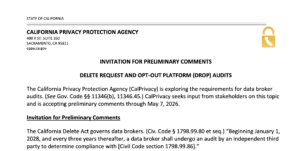
The California Privacy Protection Agency (CPPA) has opened a preliminary consultation aimed at one of the most persistent challenges in privacy regulation: making consumer privacy

California’s privacy regulators have once again demonstrated that compliance failures often hide in the operational details of privacy programs. In a recent enforcement action, the

Meta’s Ray-Ban Meta AI smart glasses promised a seamless blend of fashion and artificial intelligence, allowing users to capture moments hands-free, ask questions about their

“Students trying to go to prom or a high school football game shouldn’t have to leave their privacy rights at the door.” — Michael Macko,

In a major development for privacy enforcement, the California Privacy Protection Agency (CalPrivacy) has thrown its weight behind a first-of-its-kind whistleblower protection and incentive bill

California has a well-earned reputation as America’s de facto privacy regulator. When California moves, the country eventually follows. The CCPA reshaped how every U.S. business
Copyright © 2026 Captain Compliance | Cookie Transparency Powered By
730 NW 9th St, Fort Lauderdale, FL 33311 | +1 (954) 408-2192 | heroes@captaincompliance.com